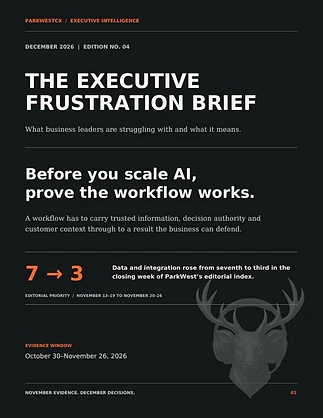
What should leaders prove before scaling an AI-supported workflow?
Prove that one workflow produces an accepted business or customer outcome at a cost you can defend. Test representative cases and exceptions. Make sure the people and systems handling the work have the right context and that a named person can intervene when it goes wrong.
September described execution debt. October traced it into the customer experience. November asked whether leaders could defend the changed workflow’s cost and outcome. This edition asks whether the information and authority needed for that outcome reach the next person or system.
What changed across the four weekly reviews?
1. Financial proof remained the first concern
ParkWest observation: Financial proof ranked first in all four weekly editorial indices. Consumption economics moved from fourth to second in the second cycle and held there. External findings: A Gartner survey of 275 customer service and support leaders, fielded in July–August and published November 4, found that 4% of customer service organizations had achieved their expected AI ROI [1]. Airbnb separately reported that roughly 40% of its Q3 customer support issues resolved without a human agent and that support cost per booking fell more than 17% year over year [2]. Airbnb’s disclosure describes its own operation. The outcomes and populations differ.
ParkWest analysis: Measure cost per accepted outcome, including usage, integration, review, rework and recovery. Compare it with the current workflow at a comparable quality level. Capgemini’s September survey of 500 executives at large organizations, published November 12, underscores the gap: nearly three in five surveyed organizations exceeded their budgets and the affected group averaged a 24% overrun [3].
2. Data and integration moved from seventh to third
ParkWest observation: Data and integration moved from seventh in November 13–19 to third in November 20–26. The weekly score moved from 97 to 100. External finding: In an Experian-sponsored September survey of 500 decision-makers at large organizations in the UK and Ireland, 17% met the study’s definition of having access to both the data and business context AI needs [5]. This sample describes the surveyed organizations.
ParkWest analysis: Test context at the point of decision. In customer service that can mean the current policy, prior actions, commitments and who can make an exception. Measure repeat contacts and customer effort alongside speed to see where work moved.
3. Workforce redesign and accountability belong in the same test
ParkWest observation: Workforce redesign rose to third in the November 13–19 cycle, and agent accountability stayed fourth in the closing week. External evidence: Adecco’s June–July survey of 40,500 workers across 36 countries linked involvement in work redesign with higher reported willingness to adapt [4]. The IAASB released initial quality management guidance for AI-enabled tools in audit and assurance on November 11 [6].
ParkWest analysis: Involve the people who will inherit exceptions. Give one owner authority to pause a defined task, and test how the team will recover an affected case.
Six Executive Signals to bring to your next operating review
| Executive Signal | Action and leadership question |
|---|---|
| AI Spend No Proof | Agree on one accepted outcome and its full cost. What result would justify the next dollar? |
| Demo vs Production | Test with real inputs, exceptions and a working fallback. Can this safely perform the assigned task in production? |
| Where Did the Time Go? | Measure verification, exceptions and where recovered capacity goes. What changed in backlog, quality or capacity after review work? |
| Who Owns the Stop Button? | Give a named owner authority to pause the workflow and test takeover. Can someone stop it and recover the last affected case? |
| The Handoff Breaks | Send the receiving person the case history, applicable rule and authority to act. Can the customer get help without starting over? |
| Twenty Ideas, No First Move | Compare AI assistance with simpler fixes and choose a bounded test. Which workflow is worth acting on now, and what would waiting cost? |
Illustrative scenario: A customer repeats an issue because the receiving agent cannot see the earlier promise. Repair the handoff and test a human-reviewed summary before expanding automated decisions. Track repeat contacts and successful resolution. Compare the cost of another month of rework with the cost of repairing and testing the workflow.
How ParkWest produced this brief
ParkWest synthesized the four Friday–Thursday research cycles from October 30 to November 26. The weekly method gives extra weight to the closing 72 hours and prioritizes direct operator evidence, disclosed methods and corroboration. Editorial priority reflects six scored factors: frequency, business impact, AI relevance, ParkWest fit, commercial trigger and momentum. The rank describes the priority ParkWest assigned to the evidence it reviewed. Survey populations and fieldwork dates differ. Enterprise evidence is prominent and Thanksgiving reduced publication volume in the closing week.
Primary sources and limitations
- Gartner. Customer service leaders and expected AI ROI. Nov 4, 2026. Survey of 275 customer service and support leaders, fielded July–August 2026. The measure is reported attainment of expected ROI.
- Airbnb. Q3 2026 shareholder letter. Nov 5, 2026. Company-reported support and cost metrics for Airbnb’s own Q3 operations. A single operator case, with no cross-company or controlled causal comparison.
- Capgemini Research Institute. The Cost of Intelligence. Nov 12, 2026. September survey of 500 CXO-level leaders at large organizations. Vendor-sponsored. The 24% average applies to respondents that reported exceeding budget.
- The Adecco Group. Global Workforce of the Future 2026. Nov 19, 2026. Survey of 40,500 workers in 36 countries and 21 industries, fielded June–July. Employer-sponsored survey. The comparison describes an association in reported willingness to adapt.
- Experian / Insight Avenue. Beyond the Model: The Power of Business Context in AI. November 2026. Online September survey of 500 technology, AI and data decision-makers in UK and Ireland organizations with 500 or more employees. Vendor-sponsored, respondent-defined access.
- IAASB. Quality management for AI-enabled technological tools. Nov 11, 2026. First staged guide for the audit and assurance context. Guidance on quality management responsibilities and risk assessment, with no survey population.
Suggested citation: ParkWestCX Executive Intelligence. The Executive Frustration Brief, December 2026, Edition 04. Permanent issue page upon release.